
Most customer intelligence software is built around a simple assumption: customer behavior can be captured through transactions and digital activity. That model works well in many B2C environments. In B2B, however, where revenue depends on complex account relationships and long decision cycles, it leaves critical gaps.
Companies still adopt customer intelligence software to gain clearer visibility into how prospects and customers engage with their organization. Marketing teams want reliable signals around campaign performance, while revenue leaders look for earlier indicators of pipeline progression, expansion potential, and customer health across strategic accounts.
However, many of these platforms emerged during the rise of digital commerce, and were designed to analyze signals like website activity, campaign responses, product views, and purchase history across very large customer populations.
Those signals remain valuable. But professional services firms and B2B organizations operate in environments where relationships between people across two organizations often shape outcomes between partners, executives, procurement leaders, technical evaluators, and operational stakeholders.
Table of contents
The fundamental split: transactional vs. relational intelligence
Customer intelligence systems generally fall into two models: those built to interpret transactional activity and those designed to understand relationship dynamics.
Most customer intelligence software analyzes activity through a transactional lens. Platforms collect large volumes of digital interaction data and look for patterns that signal buying intent. Digital interactions serve as the primary inputs from which algorithms generate forecasts, recommendations, and conversion predictions.
This approach makes sense when the buying journey can be understood through a series of transactions. Opportunity development often happens gradually through conversations, introductions, and expanding access inside an account. The trajectory of a relationship can shift when a trusted contact introduces your team to additional stakeholders, when communication between teams becomes more frequent, or when engagement from a key contact suddenly declines. Seeing these changes early depends on understanding the health and structure of the relationships surrounding each account.
The signals that reveal these dynamics appear within everyday business communication such as emails, meetings, and collaboration between teams. Together, they create a different type of intelligence.
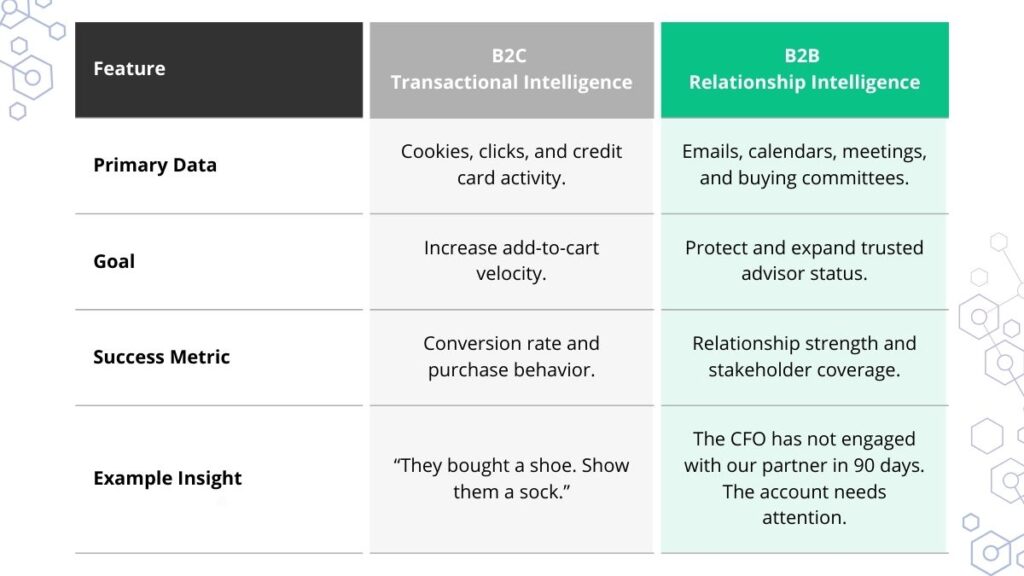
While transactional systems reveal what customers buy and when those purchases occur, customer intelligence software also needs to capture relationship dynamics: the people who influence decisions, the strength of connections between stakeholders, and how those relationships evolve over time.
3 Non-negotiable capabilities for B2B customer intelligence
Customer intelligence software solutions designed to track marketing engagement or online behavior can’t capture the signals that determine how buying decisions take shape across people, conversations, and networks.
Effective customer intelligence platforms rely on three core capabilities.
Passive interaction capture (the “anti-data-entry” rule)
The richest relationship data lives in inboxes and calendars. Professionals communicate with clients through Outlook or Gmail, schedule meetings on shared calendars, and make introductions through forwarded emails and informal scheduling threads.
Unfortunately, very little of that activity makes its way into the CRM.
Manual logging quickly produces incomplete records. After a client call, few professionals pause to document every interaction, and even well-intentioned data entry fades under the pressure of daily work. That pressure is easy to understand, as research shows sales professionals spend only about 30% of their time selling, with the majority of their time absorbed by administrative work and internal tasks.
Effective customer intelligence software captures interaction metadata automatically. The system analyzes communication patterns across email and calendar systems to identify who interacts with whom, how frequently those conversations occur, and which stakeholders remain active within an account. This approach creates a reliable picture of relationship activity without requiring teams to log interactions manually.
Relationship scoring (quantifying trust and engagement)
Activity alone won’t reveal the strength of a relationship. A client may receive hundreds of automated marketing emails without ever engaging meaningfully with your organization. At the same time, a single strategic conversation between a senior leader and a client executive can signal deep trust and future opportunity.
Customer intelligence software can evaluate the context and quality of interactions across an account, revealing how relationships develop over time. Regular dialogue with senior stakeholders reflects deeper engagement than one-way communications, while sustained interaction between executives often indicates an active strategic relationship. By analyzing patterns such as recency, frequency, and participation across stakeholders, the system builds a clear view of relationship health.
Multidimensional network mapping
Multidimensional network mapping reveals how stakeholders connect across organizations within an account. The system identifies who interacts with whom, highlights where strong relationships already exist, and exposes gaps where important stakeholders remain unengaged.
This visibility helps teams navigate complex decision environments and identify trusted paths into an organization through existing relationships and introductions.
For organizations that manage complex accounts, this capability gives teams visibility into the relationship networks shaping major decisions.
Solving the “last mile” problem: intelligence in the workflow
Even the most sophisticated intelligence platform delivers little value if teams rarely interact with it. Many organizations invest in powerful analytics dashboards only to find that usage declines after the initial rollout. The data exists, the insights exist, yet the system sits outside the rhythm of daily work.
This dynamic creates what’s often referred to as the last mile problem for intelligence.
Client-facing professionals spend most of their day inside communication and collaboration tools. They review email in Outlook or Gmail, schedule meetings through their calendars, and coordinate internally through platforms such as Teams or Slack. Very little of their time happens inside a dedicated analytics dashboard, regardless of how well designed the interface may be.
As a result, intelligence has the greatest impact when it appears within those same workflows. Relationship signals, stakeholder engagement changes, and account context become far more useful when they surface inside the tools teams already use to communicate with clients and colleagues.
When intelligence becomes part of the workflow, it appears at the moment decisions are being made. A partner or senior leader preparing for a client meeting can quickly see who else in their organization has recently interacted with the client, while a revenue leader reviewing an account conversation can identify where executive relationships remain underdeveloped. In other words, the information appears where the work is already happens.
Why Introhive is the CI platform for B2B organizations and professional services
The gap described throughout this article shows up in a familiar place for many revenue leaders: the CRM contains opportunity data, marketing systems contain engagement data, yet the actual strength of client relationships remains difficult to see. This fragmentation also reflects a broader challenge across enterprise technology. According to KPMG, 57% of organizations say flaws in their foundational enterprise systems disrupt business operations on a weekly basis, highlighting how disconnected systems can prevent teams from accessing a complete view of customer activity.
Most customer intelligence software still focuses solely on digital behavior signals such as campaign engagement, web activity, and content engagement. Those signals help explain marketing performance, though they rarely explain why a strategic account expands, stalls, or suddenly accelerates.
Introhive focuses on a different source of intelligence. In complex B2B environments, the most valuable data lives inside the communication patterns between people. Conversations in Outlook or Gmail, meetings on shared calendars, and introductions between colleagues reveal how relationships develop over time across both organizations. Introhive captures this interaction data automatically and transforms it into a structured view of prospect and client relationships without asking teams to manually log activity in the CRM.
The platform also maps the broader network that surrounds each account. By identifying who knows whom across both companies, Introhive helps teams navigate complex buying groups and uncover warm paths to new decision-makers. Professionals can quickly see which colleagues hold existing connections to a target stakeholder, allowing teams to approach opportunities through trusted introductions instead of cold outreach.
Instead of focusing only on marketing activity or pipeline metrics, Introhive provides visibility into the relationships that shape how accounts grow over time. To see how relationship intelligence can surface these insights across your organization, book a demo with our team.
BOOK A DEMO