Professionals Spend 13 Hours a Week Searching for Client Data
Without accurate, continuously captured CRM data, even the best technology falls short. This guide explores how relationship intelligence helps professional services firms turn client data into growth.
As client-facing work becomes faster and more data-driven, professionals will increasingly rely on systems that surface answers instantly. The future of CRM will depend on data that captures relationships as they evolve, giving professionals and AI tools (including agents) shared context.
Inside, we explore how professional services firms can enhance CRM data to meet rising expectations for instant insights across partners, professionals, marketing, business development, and client teams:
Director, Client & Marketing Operations, Osler
“With Introhive, it is automatic. Information is gathered passively in the background, so that insights and intelligence are mapped directly into our CRM, requiring little to no additional effort from our practitioners.”
Learn more ![]()
Beth More, Chief Marketing Officer, Grassi
“In a relationship-driven firm like ours, growth is dependent on having visibility, coordination, understanding, and timing. Having a strong relationship data foundation that tells us when, where, and how we’re reaching out, which allows us to be proactive, not reactive.”
Learn more ![]()
CRM Manager, Kingsley Napley
“I found the implementation process really really straightforward. The ability to gain insight into the Hive within the CRM has been a big win for us because everything is in one place.”
Learn more ![]()
SOC 2 Compliant | GDPR Ready | Trusted by 200+ Professional Services Firms
We offer only 10 AI-Ready CRM Data Audits per month, ensuring the data powering your AI tools is accurate and complete.
See how professional services leaders are applying customer intelligence to their digital transformation strategies to unlock growth, while strengthening client relationships during uncertain economic times.

“Implementing Introhive was one of the simplest we’ve come across.”

“It almost seemed too good to be true.”

“We now have a 97% data accuracy rate for our CRM systems which is pretty unique.”
![]()
“It’s up to date, it’s timely, it’s clean, it’s correct, it’s frictionless and it doesn’t require the fee earners or the admin support to put any manual effort into the process.”
“It’s far easier to sell to someone where you have a warm relationship versus a cold one. The insights we get from Introhive add real value to our firm.”

Because many of the systems firms rely on for client insight, from marketing tools, reporting platforms, and increasingly AI, rely on the same underlying CRM data. When that data is incomplete or outdated, professionals spend time searching for answers and key relationship context is missed and, as AI supports more client-facing work, the consequences of acting on flawed data are becoming far more visible.
High-quality data comes from capturing interaction activity automatically, enriching contact and company records continuously, and preserving relationship history as people move roles or organizations. With that foundation, firms can maintain a clearer picture of who knows whom, how engagement with their clients’ accounts is changing over time, and where new growth opportunities may exist.
As AI tools and agents begin supporting client-facing work, they rely on the same CRM data professionals use today. Meeting briefs, account insights, and recommendations are only as reliable as the data behind them. When CRM captures relationship activity continuously and preserves accurate, up-to-date institutional relationship memory across the firm, both professionals and AI systems can operate with shared context. This allows firms to surface insights earlier, maintain continuity through leadership changes or lateral moves, and ensure AI-generated recommendations reflect how client relationships actually evolve.
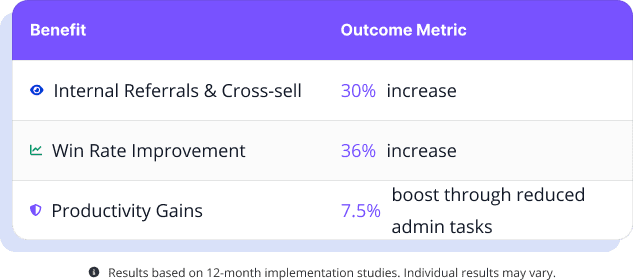
Adoption alone rarely reflects real business impact. Leading firms look for improvements in relationship visibility, data confidence, and collaboration across practices. That includes identifying warm paths into key accounts more quickly, uncovering new stakeholders within existing clients, and coordinating outreach so multiple teams engage accounts more strategically. Success also shows up in the time recovered from manual data entry and research, allowing professionals, marketing, and business development teams to focus more on client conversations and growth initiatives.